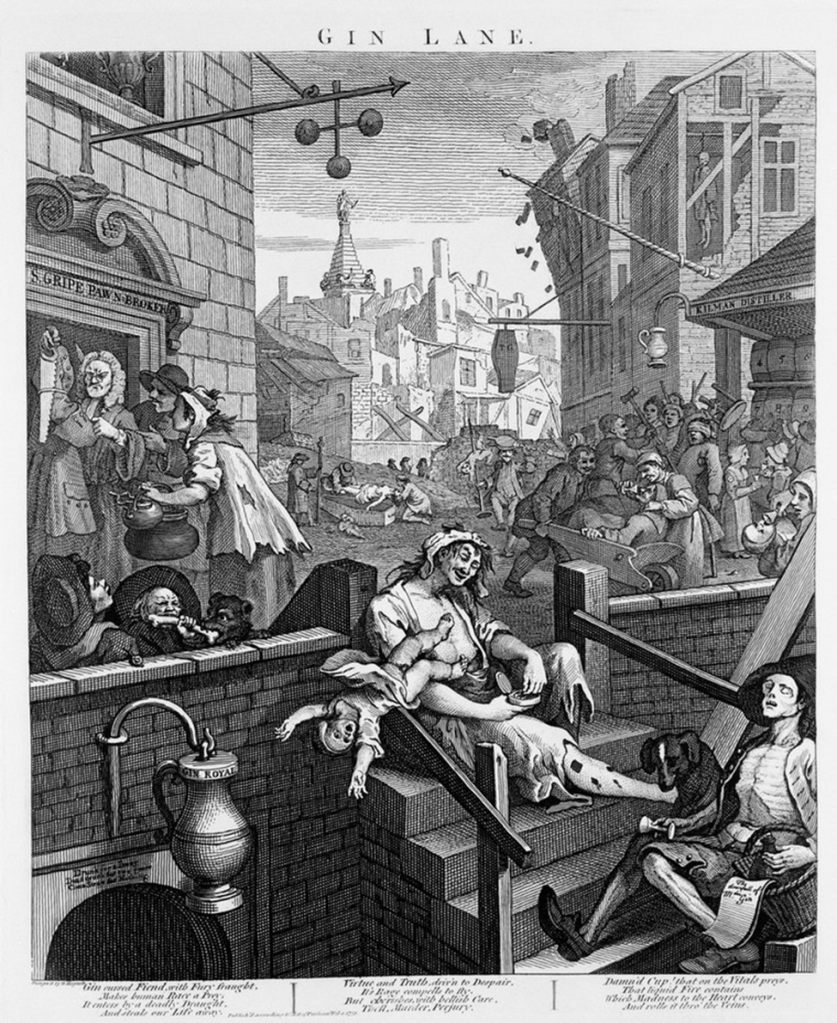
Gin, cursed Fiend, with Fury fraught,
Makes human Race a Prey.
It enters by a deadly Draught
And steals our Life away
Virtue and Truth, driv’n to Despair
Its Rage compels to fly,
But cherishes with hellish Care
Theft, Murder, Perjury.
Damned Cup! That on the Vitals preys
That liquid Fire contains,
Which Madness to the heart conveys,
And rolls it thro’ the Veins.
The Brewers’ Company of London had a charter from James I and another from Charles I confirming in the main the rights and privileges exercised by it under previous charters. The period between the granting of the latter charter and the decapitation of Charles I was productive of many measures affecting the trades in general and among them one which could not but be particularly injurious to brewing. We refer to the introduction by the revolutionary Parliament (1643) of excise-duties upon beer and ale, the very kind of taxes which Charles I was prevented, in 1626, from introducing by the determined opposition of Parliament. This tax-law, rendered more severe and oppressive in subsequent years, undoubtedly caused a change of drinking-habits among the English people. As a war-measure the imposition of this tax, like that of all the other taxes upon the necessaries of life, such as bread, meat, salt, sugar &c, seemed justifiable enough and for a time, the promise of an abolition of the taxes after the war being held out, was borne by the people without any signs of discontent. The whole scheme of what we at present style the “internal revenue” soon became very unpopular, however, and gave rise to riots and other public demonstrations of opposition. The greater part of excises were then abolished but those upon beer, malt and hops remained, increased from year to year until malt-liquors, enormously enhanced in price, yielded to the cheaper spirits, causing in after-years what is known in England as the “gin epidemic.” At first this beer-excise proved to be an exceedingly prolific source of revenue, yielding an income for England and Scotland of £446,455 in 1659. But subsequent increases of the tax-rate soon diminished the production of beer by gild-brewers and naturally led to surreptitious brewing by outsiders.
In parallel, restrictions on the importation of French Brandy were enacted. After the monopoly of the London Guild of Distillers was broken in 1690, licensing of distillers was non-existent. That opened up the trade to anyone. The beer and ale brewers were licensed and regulated. Excise taxes on beer were high but not on “Dutch Jenever”. This led to an unexpected over-consumption of gin and numerous attempts to regulate the trade in gin were enacted over the years – too little; too late.
By 1721, however, Middlesex magistrates were already decrying gin as “the principal cause of all the vice & debauchery committed among the inferior sort of people”.
The high cost of beer and relative cheapness of “Dutch Jenever” pushed the citizenry to Gin and society suffered greatly.
 Crescent City Brew Talk