From The Brewers’ Journal – January 1899
The brewing industry in the Argentine Republic has been on a progressive scale during the last ten years, until it has reached a point where it more than fills the requirements of the market. This is fairly well known by the decrease in the importation of beer which, valued in 1888 at £134,361 fell to £13,518 in 1897. In all respects the beer brewed in the Argentine is reported to compare favourably with that manufactured elsewhere. There are five breweries operating on an extensive scale and well equipped with modern appliances. Naturally the province of Buenos Aires is the seat of the industry, the number of breweries in the province being twenty-eight. The capacity of these breweries was returned as 51,229,200 litres during 1895, but the total production of beer was only 8,767,338 litres. This was 500,000 more litres than during the preceding year, but still only about one-sixth of the capacity. The pioneer in the brewing business of the Argentine Republic was Herr Bieckert. He was the founder of the present Bieckert Brewing Company (Compania Cerveceria Bieckert, Limited), whose plant is situated in the city of Buenos Aires. This brewery and the Argentine Quilmes brewery, which is situated a short distance outside of Buenos Aires, are the largest establishments in the country. The Bieckert Company was established in 1860, and in 1889 passed into the hands of an English syndicate for the consideration of £1,000,000. The Quilmes brewery, which has been established for ten years, has a capital of £260,000. The product of each of these breweries is said to be fully equal to the average light lager beer of other countries. The main product of all the Argentine breweries is a beer that is light both in colour and gravity, and contains a low percentage of alcohol; much the same kind of beer as the pale American products. The Quilmes Company makes a darker beer that is not so heavy.
The Bieckert brewery ranks among the first hundred breweries of the word. The area of the plant equals 22,000 square yards. Two extensive four-story buildings, provided with elevators and communicating bridges, comprise the main portion of the brewery. There are thirty-eight cellars, six for fermentation and the others for reserve. The beer is stored in 180 wooden and sixty slate vats. The establishment has two 100-horse power boilers, six 70-horse power boilers, and one 40-horse power engine. The machinery is all of French manufacture. The refrigerating plant comprises five machines. The water used in the brewery is obtained from three spring wells. There are four bottle-washing machines, each having a capacity of fifty dozen bottles. From these machines the bottles pass to other apparatus where they are finished by means of sand and water. After an inspection they pass to the filling department, where they are filled and corked by machinery. The same care is bestowed on the cleansing of the barrels. Some of the retail customers of this brewery have fixed tanks in their cellars which are filled by means of pipes from casks from the brewery. These tanks are kept in order and periodically cleaned out by the brewery free of charge. The brewery employes number 500, and the establishment has twenty-four wagons in its delivery service. It ships extensively to the interior of the country.
The principal beers made by the Bieckert Company are: Pilsen beer, which they advertise as the “Queen of White Beers”, bock beer and La Africana, which is advertised as “the superior of all the black beers.” The brewery makes a special note in its advertisements that no corn or other injurious substance is used in the manufacture of its beers.
The Quilmes brewery, located in the pretty village of Quilmes, thirteen miles from Buenos Aires, is worked much on the same lines as the Bieckert brewery. The capacity of the Quilmes brewery is 14,000,000 litres annually, and its product has not alone a large local sale, but is exported in considerable quantities to Uruguay, Bolivia, Chili, Paraguay, and Brazil. The Quilmes beer is stored for at least two months before being sent out. The equipment and organization of this plant are excellent. Its machinery is all of French manufacture. The capacity of the bottling machinery, which includes the latest devices, is 5,000 dozen per day. The water is drawn from three spring wells by five pumps, and there is one ice-making machine, having a daily capacity of seventy-five tons. Power for the machinery throughout the establishment is supplied by two 100-horse power engines, supplied by four boilers, which consume from nine to twelve tons of coal per day. The brewery imports malt from Europe. It also makes some malt, using both imported and domestic barley. It always has a quantity of ice on hand, some of which is used to cool the beer in transport through the country, and the rest of it is sold to the public.
Another well-known establishment is the Anglo-Argentine brewery (Cerveceria Anglo-Argentina), at Cordoba. This plant occupies 2,500 square yards. Its machinery includes three 25-horse power boilers, and an ice plant with a daily capacity of fifteen tons. The brewery employs sixty men. In a plant adjoining whisky is also made.
An establishment of about the same capacity, making about 5,000 litres weekly, in the same province, is the St. Vincent brewery (Cerveceria San Vincente) of William Ahrens, located at San Vincente.
Another typical brewery is that of Frederico Rothenburger at Buenos Aires, whose establishment occupies about 6,000 square yards. Power is furnished by a 60-horse power engine, and the plant includes three coppers, each of a capacity of 3,000 gallons. An ice-making pant produces from four to five tons of ice per day, whatever is not required by the brewery being sold. The best-known brands of this company are the double beers known as Rubia and Nagra. It also makes porter and XXX beer and various qualities of pale lager beer.
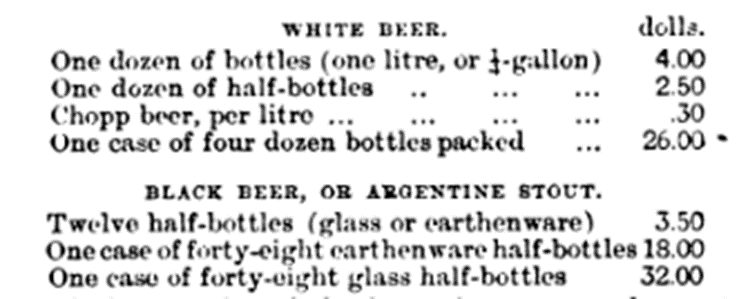
The National Brewery Company (Fabrico Nacional de Cerveza), a new organization which bought out the business of Pagasano and Co. at Buenos Aires, quotes the wholesale prices of its product as follows from August 1, 1898, the money terms used being the Argentine currency, 2.75 dolls (one dollar equal to 2s).
With the capacity of the breweries very much greater than the production, the importations of beer are necessarily restricted. Only such beer is brought into the country as is demanded by the epicurean tastes of the foreign residents. Thus, out of £15,853 worth of beer imported during 1896, £13,796 represented British beer and porter; the importations from Germany and Belgium amounted to only £1,101 and £931 respectively. Argentine beer is “protected” by an import duty of thirty cents per litre in barrels or demi-johns, and twenty-five cents per bottle in bottles, Argentine currency.
The cultivation of barley in the Argentine has not been very successful, the quality of the crops being much depreciated by recurrent droughts and the ever-present devastating locusts. The area under cultivation in the province of Buenos Aires alone last year was estimated at 75,000 acres, yielding about forty bushels per acre. Argentina is both an exporter and importer of barley. It was in 1876 that the republic first began to export the cereal, beginning that year with a shipment of sixteen tons, and continuing to export through succeeding years up to 1895, when the exportations amounted to 8,990 tons. As the production increased Argentino purchases of foreign barley decreased from £9,168 in 1888 to £5,737 in 1897. The latter imported in 1896, which was valued at only £1,901. This was due to the poor crops. Great Britain supplied £1,337 worth of barley; Germany £447; and the United States only £9 worth of the 1896 importation.
Both the Bieckert Brewing Company and the Quilmes Company are interested in barley-growing lands. The increase in the importations of barley last year, just referred to, would indicate that the quality of the barley being raised is not good enough for brewing requirements. If it were, so much of it as was wanted would be kept at home to save the import duty of two and a half centavos per kilogram (2.204 pounds) on cleaned and three-quarters of a cent per kilo on uncleaned barley. For the same reasons that apply to barley, malt is imported in considerable quantities, the value of the importations during last year amounting to £34,528. The importations during the preceding year amounted to £32,221, of which Germany supplied £31,987, Belgium £131, and Great Britain £105. The duty on malt is 10 per cent ad valorem. The amount of hops purchased by the Argentine increased from £5,136 in 1895 to £6,713 in 1896, and during last year amounted to £6,701. Germany supplied £5,170 worth, while Belgium sent in the commodity to the value of £1,989. Great Britain supplied £145 worth. Hops pay a duty of 2½ per cent ad valorem.
The Argentine beer is put up in bottles and barrels, the retailers in the larger towns being supplied mainly in barrels. Shipments in quantities to the interior are occasionally made in barrels also, the beer being kept cool by means of ice. The more general way of shipping the beer to a distance, however, is in closed cases containing four dozen bottles. Empty barrels and staves for barrel making are admitted free of duty. The value of the casks, barrels, and staves imported into the Argentine during 1895 was £43,598, these goods to the value of £17,035 being imported from the United States and to the value of £8,510 from Belgium. Germany sent them in, to the value of £5,164. The importation of glass bottles of all kinds fell off from a valuation of £70,078 in 1896 to £60,334 in 1897. Most of the se goods were obtained from Germany, whose share of the trade amounted to £42,503, Belgium ranking next with £9,000. The amount purchased from the United States amounted to £2,026. The duty on glass bottles is 25 per cent ad valorem. The machinery used in the breweries is nearly all of French manufacture. A little of it is from Germany. Machinery generally pays a duty of 10 per cent ad valorem when it exceeds a value of £20.
 Crescent City Brew Talk