I found this article on a brewing forum. The unidentified author lives in Igloolik; an island north of Hudson’s Bay in northern Canada. I coudn’t even imagine the difficulties and impediments involved in home brewing at society’s edge before reading this.
PART I The background and struggles of brewing in the far north.
I thought I’d never have something interesting enough to put into an article, then somebody suggested I do one up on brewing in the north. At first, I didn’t think there’d be enough content to cover a full article. But as I thought about it, I thought of more sub-topics that could go into such an article. Part I of this article will not cover my brewing practices, but rather the factors that affect my brewing. The environment you have plays a huge role in how your brews turn out, how long they last, and how much you put into it. This is my environment.
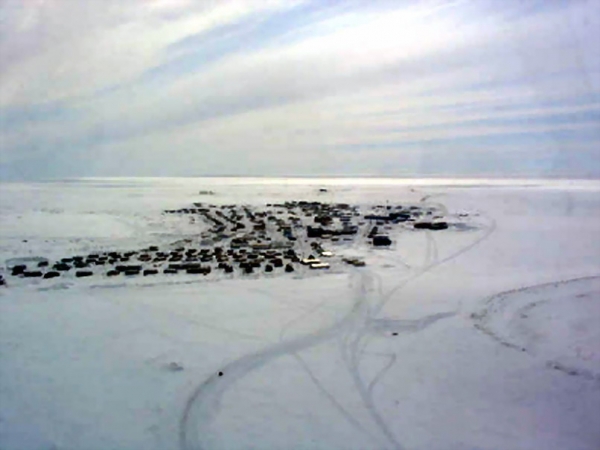
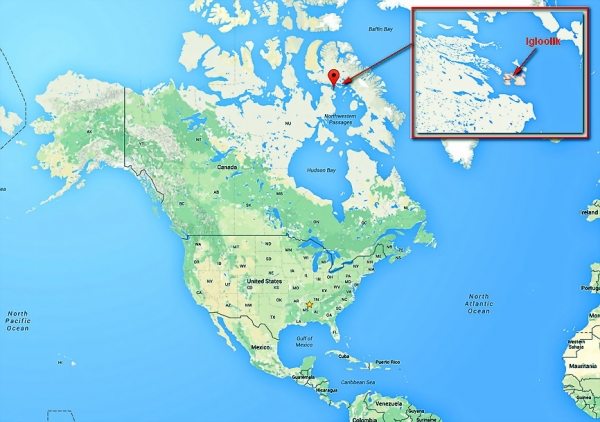
First, a little more info on where I am: the small island of Igloolik, tucked away in Canada’s Arctic. A small population (but still more than most communities up here!) of about 2,400 means everybody almost knows everybody. I can walk across town and back in about 30 minutes.
Supplies are limited to what can be found at the local Northern and Co-op store. Spare parts are usually obtained by heading up to “Canadian tire”, otherwise known as the dump, and scavenging through what others have discarded. You can get auto parts, lumber, half-decent furniture, appliance parts, firewood, and if you’re hungry enough, expired food from the stores (very few are this hungry, but it has been known to happen).
The internet is slow. I’m sure there are terrorists in caves on the other side of the world with better internet access than I’ve got. Once you pass your 10 gigabyte cap for the month, you either get put onto something slower than dial-up (it has taken me over 30 minutes for Microsoft Outlook to load my inbox), or spend $20 per gigabyte for the rest of the month. Even with ad-blocking extensions on my browser, loading this forum could take hours.
Now on to the brewing-related aspect of this article. There are many reasons I should NOT be brewing in this community, and only a couple reasons why I should. Those are weighed here, but the fact that I’m on this forum, with this ISP, should be a good indicator of which way I went.
This town has a limited flow of alcohol. There are three ways to get it here.

Purchase it from the local Alcohol Education Committee.
Pictured above, the Alcohol Committee building has no signage because everybody knows where it is. This option is the most common, and also the most expensive, once you’ve paid for it. First you go to the AEC building and place your order. Every Monday, the board members will review the orders, and approve or deny the orders based on your history with alcohol, and whether or not you live in the same house as somebody they don’t want having it. You’re only allowed to order a limited amount per month (up to 12 of each item), and they track who’s ordered, and how much they’ve ordered. If you’re on the “Do not share” list, then you’re not allowed to order at all. I will refer to this as the “blacklist”.
There are a couple of ways you can end up on this blacklist. Those ways are usually bootlegging, sharing with members on the blacklist, or get repeatedly sent to the drunk-tank. One person was arrested in Montreal last year for being drunk, and wound up on the Igloolik blacklist, and still is listed today. The more people there are on this list, the more buyers you have for bootlegged booze, which ultimately leads to more people on the list.
I placed one order through this committee, and after having paid $300 ($100 of this was paid at the airport, for the cargo fees) for two bottles of rum and a cheap box of wine, decided I valued my money more than a drink.
Smuggle it in your airline luggage
This is common, but with CATSA (Canadian Air Transport Security Authority) in Iqaluit scanning luggage, not as much will make it into the community. Usually only shared with family members, however people will try to sell their excess drinks. A mickey (for you Americans, this term refers to a small bottle, usually 375 ml) will go for about $150.
There are people who will fill up bins with booze and bring it in as luggage, and then make thousands of dollars selling it to friends and relatives.
Make it yourself
Usually people who make their own are going for moonshine. However, including myself, there are only three people in town who make beer and wine. It is generally not advised to announce to the town that you do, because this is the best way to get your home broken into. Luckily, Inuit are a short people, because this makes me one of the biggest people in town. If somebody broke in, I could just sit on them!
You do need permission from the Alcohol Committee to begin brewing. I got verbal permission from one of the board members before I began, and informed the RCMP that I would begin having “large quantities” of beer and wine (in this town, a 5 gallon batch is a large quantity!) in my home.
Shipping costs
Living in a remote community in Canada’s Arctic means you will constantly be paying higher rates on everything. There are no roads, which means everything is flown in. Everything from the “white” food we eat to the clothing we wear comes in as air cargo. This adds to the costs considerably. If you were to Google “food prices in the north” and you’ll see the prices we pay even on the healthy subsidized goods!
But the store isn’t the only place we pay more. Online shipping has recently been increased on sites like Amazon.ca, and Costco. A $40 box of diapers will cost $160 to ship from Amazon. Prime memberships are not an option once you’ve input your home address as a remote community.
This means that heavy items like Liquid Malt Extract and bulk orders of dextrose or grains will cost quite a bit to ship. Hops are smaller, but because mail comes in on an aircraft, it’s still comparatively expensive to ship. I tend to use eBay sellers that offer free shipping after X amount has been spent, or don’t adjust their shipping quotes once I’ve input my postal code. These sellers lose quite a bit of money at the post office, and I won’t be surprised if they adjust their policies in the future.
Once a year, we get the sealift. Many people in town order a year’s supply of household supplies (detergents, toilet paper, paper towel, dry food, the occasional vehicle). Pictured above, this is what came out of the last two sea containers. Hundreds of the sea containers were offloaded here just last week. If I had plans to be here longer, I would definitely order a crate full of LME, DME, dextrose, grains, hops and whatever else I could think of that would help this hobby. I would have the most backed-up pipeline in the entire territory! However, this is a large upfront cost, and the costs of living here are quite high. I’ve spent $50 on a 2kg bag of chicken at the store! As such, I haven’t been able to save much.
Addiction
Addiction in the north is quite the problem. Everything from sniffing gas to alcoholism causes problems here. A school in Cape Dorset recently burned down because some pre-teen kids were sniffing gas underneath the school (due to permafrost, all buildings are built on blocks 5 feet off the ground).
And because alcohol is a limited commodity, moderation is NOT generally something used to describe drinking habits. I know of at least one person who will take the day off work once her order comes in, just so she can drink it all before somebody steals it. A few people up here, who have spent time in the south, have said they were surprised how little drinking occurs when somebody has a “large stash”. The concept of social drinking is a foreign one. When I said I was done after a couple of rum and cokes, I was asked “Why?” When the response was “I don’t want to get drunk, I have work tomorrow”, they were genuinely confused.
One of the other homebrewers in town is married to an alcoholic. He has told me that in 2013, the door to his brewing room had to be replaced 7 times because she kept breaking in while he was away on business. I assume he’s replaced it many times since then.
When I make a batch of wine, my mother’s half of it is gone within 2 days. 15 bottles, two days! I don’t know how many people she’s sharing it with, but assuming she’s only sharing with two people, that’s still a lot of wine gone.
There’s no way to say this without sounding racially insensitive, but I’ll just come right out and say it: Inuit don’t know how to drink. There is no “rationing”. They will drink until they can’t stand, or until there’s nothing left to drink. This brings me to my next point:
The Royal Canadian Mounted Police
Not only do I work at the airport, but I also moonlight as the jail guard. And there is a LOT of babysitting to do. Every time somebody causes a ruckus, it’s usually because somebody drank too much. The intoxicated person is brought in, their personal belongings put into a locker, and then they are put into the “drunk tank”.
This is where they ask the intoxicated person where they got their liquor. I assume this is where most of the intel about bootlegging comes from. Drunk people aren’t known for lying, and so if they get a name that wasn’t on the list of people who made recent purchases from the AEC, they’ll know who’s getting unauthorized alcohol. While this particular segment isn’t really relevant to home brewing directly, this is the reason I’m careful about who I invite over for drinks. If my guests are known for winding up in the drunk tank, then my permission for home brewing goes out the window. While I’m unsure if they’d be able to confiscate my equipment, I know I’d definitely lose my job at the jail, and that job pays too well for me to be handing out drinks willy-nilly. As it stands, only close family (the ones we trust, anyways) are invited over.
Bootlegging
I’m not going to lie. The temptation to sell my drinks has been strong. It still is. There wouldn’t be enough space under my mattress for all the money I’d be making. However, for some strange reason I’ve yet to fathom, I have not began bootlegging. The only reasons I could give myself for not having done so are my two jobs. I would lose the security clearance and trust from the RCMP, and would not be working there again. I would also lose the benefits of working for an airline; cheap flights and cheap cargo. The bosses know I use my discounts on brewing supplies (I only pay 20% of the cargo rate), and so if I were to begin abusing those benefits to make a profit on alcohol, those privileges would be revoked as soon as the RCMP had paperwork on it. I think I enjoy my Chinese food too much for that (I fly to other towns to pick up dinner, and fly back the same day).
Most people offer money in exchange for drinks. I get many midnight phone calls from people who think they can convince me to part with a bottle or two. At least a handful of women will offer “alternative payments” for those drinks. This is a result of my mother (up here, if you don’t live with your family, you are a rich person indeed) telling all her friends when my batches are done. Those friends tell friends, then those friends tell their friends….a friend of mine from Ottawa made me laugh with this…
“I’m gonna see u on the news soon…a new beer baron has emerged in one of Canada’s most northern communities. An up and comer making enemies as he steals the women in town…”
Summary
Being one of the handful of people who have a nigh-infinite supply of beer and wine in a restricted town has led me to see a different side of much of the populace. Not only does my job at the jail allow me to see how people act when they’re intoxicated, but being stopped in the streets or approached in line at the grocery store shows me how desperate many of these people are for a good drink.
Note: This is the first part of a two-part article. Part II will be released next. In it I will discuss some more of the environment and my brewing practices!
PART II My brewing practices, as made necessary by my environment. But first, a few notes on that environment.
Water is, I’m sure we can all agree, the most important ingredient to brewing beer and wine. As such, the quality of the water is important. I will admit, that I haven’t read any of the many posts regarding water quality, water analysis, water treatment, or water sources. I haven’t read them because up here, there are three sources of water, and treating them isn’t something I’m capable of. The three sources of water are:
Tap water
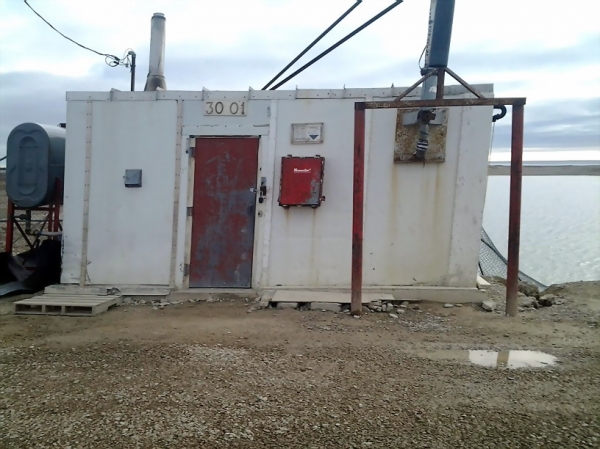
Water from the tap is delivered to our homes via large tanker trucks. There is a flow switch which activates a light outside the house when the water level is low, and when the light comes on, any passing truck knows to stop by and fill it up. This water is picked up at the reservoir, which has a few chemicals added to it somewhere between the open body of water to the truck. The pump house is shown in the above photo. This water, while potable, isn’t necessarily the best. We often find bits of sand at the bottom of our glass, and once in a while has a slight yellow tinge to it. Just recently, there was a Boil Water Advisory. Though that has since been resolved, I have switched to using reverse osmosis water from the stores.
Because the water in our homes is limited, I don’t use a wort chiller. The only way I could use a wort chiller is if the water could be run back into the house tank. While this is possible as the delivery pipe is just outside my living room window, I’d rather not keep my window open that long in the middle of -60 C winters.
Store Bought Water
The reverse osmosis water you can buy from the store goes through several filters before it comes to you in half-liter “squirts”. You simply place your water jug/bucket under the spigot, and every time you press the button, half a liter gets squirted into it. This takes time when you need a 6 gallon bucket filled, but at least I know the water is clean. If I don’t want the town to know that a batch of beer or wine is about to get made, I’ll simply use the 5 gallon water jugs you can buy at the store. I made the mistake of filling up the Ale Pails directly one time, and everybody I passed by knew what was about to happen once I got home. The following week I had received so many phone calls from people looking for some drinks that I made sure to always use unmarked containers after that, but at this point people know what it means when I’m picking up water.
Ice and Snow
As you can imagine, people will have large chunks of ice hauled in out of the sea, and leave them outside their homes. The locals are able to tell the difference between fresh and salt ice, and so they use the fresh water blocks for their tea and coffee. I’ve tried using this in a batch of beer once. While the Cerveza turned out great, the effort involved in collecting enough snow and ice to melt and boil for a 5 gallon batch was simply not worth it. I have since vowed to stick to the R/O water from the store.
My Keezer
It took some doing, but I finally managed to build a keezer for myself. Given the shipping rates I paid for the parts, and the cost of the freezer from the local Northern store, I wound up paying just about $1750 for a 2 keg system.
I noticed that of every 5 gallon batch I made, I was able to drink 6 bottles. The rest seems to have grown wings and flown away on their own. Between people helping themselves, and my little brother trading them off to the weed dealer, they weren’t lasting that long. I needed a way to keep this liquid gold inside the house. So I began purchasing piecemeal parts to build this keezer. It took several months (6 months for the CO2 in transit), but it’s finally complete.
Now I’m the ONLY guy in town with cold beer on tap! There’s nothing quite like coming home after work and being able to pull a pint into a glass. And the best part is, I can put whatever I like into those kegs!
Want an IPA? It’s a little hoppy for my tastes, but it’s there. A Cooper’s Canadian Blonde is a great refreshing beer to have with dinner. The stouts I still put into bottles, but the Brewer’s Best Summer Ale is great in a keg! (never mind summer, we go from Spring to Autumn here).
I’ve even got my mitts on a pair of walrus tusks, which I plan on having made into carved tap handles. Problem is, the GOOD carvers will cost quite a bit. But I don’t want just any old hack working on these tusks, they’re valuable even in this untouched state.
About a third of the cost of this keezer was the CO2 tank itself. Not only did I have to find a place in Ottawa that sold them (which was easy enough), I had to pay another homebrewer to pick it up, pack it for shipping, and deliver it to the airport with the appropriate paperwork. Then comes the Dangerous Goods paperwork (which has an upfront cost), and the cargo shipping fees. This 10 lb tank cost me $455 all told. Talk about motivation to prevent leaks!
Having a keezer, however, poses another problem. It’s another target for break-ins. If it gets around that there’s 10 gallons of beer available on tap, then it’s another reason for me to lock the door at night. The tap locks were a necessary expense (at $70 each for the model that fits a 630ss, PLUS shipping!). These locks also prevent all the sudden guests and visitors we have from being able to help themselves. Unfortunately, my mother (who lets me live here rent free, so I feel obligated) expects me to be a good host and allow HER guests to have all they want.
High cost of Power
This one is fairly straight forward. The cost of power in Igloolik Nunavut is very high at $0.63 per KwH. This means that our electric stove should NOT be used for extended boils, especially given how many watts you’d need to bring a large pot to a boil. It is for this reason I only boil about 1 gallon of water to mix in the sugar and LME kits.
This is also the cost of my keezer’s power. This appears to be listed at 242 KwH/year, so it’s not so bad, assuming the STC 1000 doesn’t affect this number too much.
Just running my customized Alienware gaming computer (I tend to game around 8 hours a day at least) causes my hydro bills to come up to $700. This goes up if my brother is home playing on the Playstation downstairs.
Outdoor climate and weather
The temperature outside can reach levels as low as -60C, if you include humidity and windchill. This means that I can’t do outdoor boils. The land around is quite flat, which makes the wind a ferocious beast that’s constantly battering on the doors and windows of our homes. Even if I had access to propane, the heat would be blown or drawn away from the burner and pot.
Manufacturing a sort of flashing around the burner and pot would further add to the costs. I have simply resigned myself to sticking to the pre-hopped LME kits I can buy online.
This outdoor weather could provide an alternative to wort chilling. But since I use the pre-hopped LME kits, there is no need to chill the wort.
In the middle of winter, the crawl space under the floor by the front door makes an excellent location for lagering. This area is usually between 6 and 13 degrees, depending on how close to the hot water tank I want to get. Due to the CO2 that comes out of the fermenters, I’m unsure if it’s a good idea to have it close to the hot water tank at all, so I haven’t tried to lager more than twice.
Northern built homes
Homes built in the arctic are usually on a budget, which means large spacious homes are a luxury nobody can afford. If you want storage space, then you’re meant to build a shack of your own somewhere on your property. Many people use the plywood and lumber from disassembling their sealift crates, or scavenge the lumber from “Canadian tire” (the dump). A few have purchased the sea containers and use those as their sheds.
These aren’t heated, so these are for storing excess furniture (you can afford excess furniture? Rich family indeed), hunting gear, tools, spare parts and other such items.
Inside the homes, there isn’t much space for storing brews. I currently use my bedroom closet for storing bottled goods. There is a crawlspace near the back door I use to store empty bottles, fermenting brews that are kept at room temperature, and unused brewing equipment. In my case, this equipment is limited to Ale Pails, hoses, stir spoons and siphons.
The smells that come out of the fermenters are able to spread out to the whole house. If you were to visit my home during the fortnight after brew day, all you’d smell are the gasses coming out of those buckets.
Propane
If I were able to brew outdoors, or even in the nearby shack, I wouldn’t have the propane to do it. Given the headaches that getting a can of CO2 up here caused, I do not want to try getting propane. I could get a canister of it through the sea-lift, but I don’t want to have to buy a year’s supply of it.
There is a source of naphthalene gas, but everybody in town seems to use that for their Coleman stoves. I don’t want to compete with the hunters, trappers, and those who live out in cabins for this gas just to make something I can do on my kitchen stove.
Brewing
Now that I’ve covered the parameters of my environment, on to my actual brewing. This is not going to be that extensive. For all the reasons stated thus far, I stick mostly to the kit n kilo process.
StarSan is quite acidic, and as such, qualifies as a Dangerous Good, and cannot be sent by airmail. I had to order a 5 pound bucket of One Step white powder for my sanitation. I use a tablespoon of this in a 1 gallon bucket of water to sanitize everything. The label on the bucket says it sanitizes on contact. I make sure everything gets wet with it, but at this stage all I need to sanitize are the bucket, spoon, hydrometer (lately haven’t been using this), and thermometer.
Once I’ve brought a gallon of water to a boil (and have a can of Coopers LME sitting in a pot of hot water), Ill pour it into the bucket and mix in the sugar. Then pour in the LME, and fill the LME can with hot water. Stir this to get all the LME I can get, and pour that into the bucket as well. Stir this hot mixture until it’s all dissolved in the water, and then pour in 3 gallons of pre-boiled cool water. Pour from a height to get some splash aeration. Take the temperature. If it’s outside the temp range of the yeast packet that came with the LME, then add the last gallon of warmer/cooler water.
Once it’s at temp, I sprinkle in the dry yeast packet on top of the foam. Lately I haven’t been using the hydrometer, because it has always been within the range specified in the instructions found under the lid of the LME. Put on the lid and airlock, and place this bucket in the back crawlspace for about 10 days.
For the next week, the entire house is going to smell. I find it smells like the Ontario Beer Store. Kind of like somebody poured beer on the floor and left it there. I’ve heard from somebody that if my ferments smell like beer on the floor then I’m doing something wrong. However, the beer has always turned out good (with the exception of 2 beers infected). I’m not sure what needs to change, if anything.
After about 10 days (and two days of hydrometer readings), I usually batch prime, then bottle. Since glass bottles are hard to come by up here, I tend to use soda bottles. But I have had glass bottles, so I’ll explain how I bottle those.
Since crown capped bottles are about as plentiful as flying pigs, I have to use threaded bottles. You can still put crown caps on them! I have a small wing capper that still does the job. I find I just pull down on the wings and listen closely for the sound of the glass stressing. I can also feel the tension in the glass, and have learned how much will actually break the neck. Only about 1 in 5 Labatt Blue bottles will actually completely cap, and perhaps 1 in 6 of Molson Ex bottles. Then I test the caps with a light pull of my fingertips. In every 5 gallon batch I bottle into these threaded bottles, only 1 will not be air tight. For the Pepsi bottles, those are fairly straight forward. Sanitize, fill, twist the cap on, and keep in a dark room.
In this home, I find I have a hard time making any of these batches last two weeks. After about 4 days, my mother will be getting into the bottles because they’re good enough. Personally, I don’t find them to be drinkable until a MINIMUM of 1 week in the bottle, but they’re better after 3, if they last that long.
The old lady tends to invite all her friends over once she starts dipping into the bottles, and by the next day, more than half the batch is gone. Then I’m expected to split what’s left between myself and her, then she will share her half with others, and come asking me for more. I live there rent free, so I feel obligated to share. I chalk all this up to experience in learning to brew, and the tax on this experience is about 90% of my product. Meanwhile, I’m anxiously awaiting my return to Ottawa.
Summary:
All in all, home brewing is a rewarding hobby (I imagine it’s much more rewarding if you can go all grain!) that allows you to experiment with everything from the water, the temperatures, the ingredients, and even how much time it spends in a vessel. It is also a source of annoyance, grief, and wanting to throttle everybody you see. It is equal parts joy and anger, for me.
I hate that the town is full of alcoholics who are constantly looking for an excuse to drop in. I hate that my mother, who would share the last scrap of food out of her pantry if you were hungry, also seems to think she’s required to share *MY* hard work with others.
I love that everybody enjoys something I made. However, I’m sure I could skunk every bucket I make and they’d still drink it, so I don’t know how much pride I should have with my work.
If it weren’t for my decision to return to Ottawa, I would definitely continue brewing. As it is, I’m trying to find a local buyer for my keezer (even with my airline discount, If I were to bring it with me, the cargo rates would be more expensive than building a BIGGER keezer in Ottawa), and using that money to facilitate my move.
This town is where I began my foray into home brewing. While I’ve stuck mostly to pre-hopped kits of LME by Coopers and Muntons, I have done some minor experiments with different sugars (very little effect on the final product) and hops. I eagerly await my return to the south, where I would be able to afford to play with different grains and wheats to get those chocolate, caramel, and honey flavours I’ve been wanting.
Now that this town has taught me valuable lessons in penny-pinching, dissemination, discretion and working with limited supplies, I want to see what I can do in a place like Ottawa where supplies and equipment are easier to come by.
Wish me luck
 Crescent City Brew Talk