By Mike Retzlaff
I recently read a rather long but interesting paper about wort boiling. It was in an old brewing Journal from 1905. The focus was on using steam heated kettles versus direct fired kettles.
The experiments cited in the paper showed that worts boiled in kettles directly fired seemed to produce beers which became bright quicker and showed better stability. This was in comparison to the worts boiled in steam heated kettles under pressure from 4 – 45 psi. The worts heated by steam reached temps of between 218o @ 4 psi to 265o F @ 45 psi.
Later in the article it disclosed “In the latter case, even working with 60—80 1b. steam pressure, the contact temperature never exceeds 279°—300° F. whilst with the fire-heated copper the temperature of the plates far exceeds these temperatures.”
Yet, the directly fired kettles produced, in general, a better beer. “With a fire-heated copper we have upon one side of the copper plates an intense heat, on the other, comparatively cool wort. If the setting of the copper is well designed, circulation of the wort is excellent, and a vigorous boil results; but the wort momentarily impinging upon a super heated surface is subjected to a high temperature and this we believe is the secret of the observed differences between fire and steam heating.”
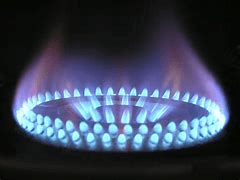
“That contact temperature has an important bearing upon the stability of the beers was confirmed in an unexpected manner during the course of our experiments. The beers, boiled in our fire copper, suddenly, and without apparent reason, showed a lack of stability, they quickly showed haziness, and their character was not so permanent; they were, in fact, little better than the beers produced by boiling with steam. On investigation, it was found that the gas burner employed for heating the copper had become dirty, so that instead of burning with the usual non-luminous Bunsen flame, a luminous smoky flame resulted. In consequence, the bottom of the copper had become covered with soot. Since soot or carbon is a bad conductor of heat, it was evident that the contact temperature had been lowered to a point approximating to the temperatures of the surfaces of a steam-heated copper. We thoroughly cleaned the burner, and removed the coating of soot, and with our first trial we again obtained results which showed the superiority of the fire-boiled over the steam-boiled worts.”
The discovery revealed in this last paragraph admonishes those of us who use a gas burner to make sure our kettles are free of soot build-up and that our burners are regularly serviced to free them of soot, rust, and debris.

 Crescent City Brew Talk