Journal of The Institute of Brewing – 1919
Paper presented by
H. L. Hind, B.Sc, F.I.C. and Captain R.A.S.C. Julian L. Baker, PJ.C.
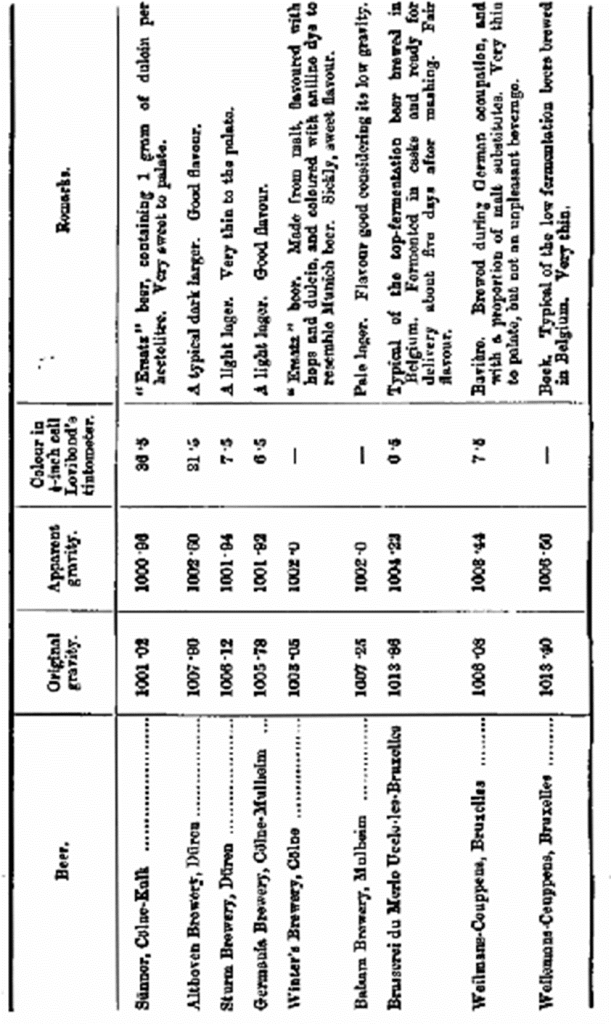
Tub beers, the analyses of which are quoted below, were collected at German and Belgian breweries between December 11th, 1918, and the end of February, 1919. The German beers were brewed before the districts were occupied by the British, and the Baviére was brewed at Brussels during the German occupation.
The standard strength of the German lager beer at the time of the allies’ occupation was 1008°. Inclusive of a tax of 5·5 marks, the price was 34·5 marks per hectolitre.
Owing to the shortage of malt the gravities of German beers wore progressively reduced. In 1914 they averaged 1048°, in 1915, 1024° in 1916, 1016°, and in 1917 they wore as low as 1006°. The supply of hops was adequate. The beers were of a light Pilsener character, and, notwithstanding the low gravities, the flavour was, in many cases, quite good. The dark lagers were decidedly sweet, owing to the addition of dulcin, which was added in the proportion of 1 to 10 grams per hectolitre. In the various breweries visited the quantity of the dark lager brewed was small, and in its place an “Ersatz,” or imitation beer, was produced from dulcin, hops, and saponin, and, in some cases, from an extract of hops and re-mash of the grains. The “Ersatz” beer was in certain districts its manufacture was prohibited. was produced. sometimes slightly fermented and put into the lager casks for a day or two. Its flavour resembled a very sweet, rather nauseous, hop bitter.
The brewing processes were carried out much the same as before the war; there was, however, a reduction in the time of lagering. All the copper vessels and mains from the mash-tun rooms were bought up by the Government at a good price, and were replaced by iron.
The output of the breweries was limited by the regulation which permitted the use of 5 per cent, of their 1912 quantity of malt in the year commencing October 1st, 1918. It was only by the production of the “Ersatz” beer that anything approaching an adequate quantity
In Belgium, the position of the brewers during the occupation was very difficult. Their copper vessels and pipes had been requisitioned, and, in many cases, the breweries were ruthlessly demolished. In most districts or towns only one brewery was left in a condition to carry on with iron vessels, the other brewers being obliged to have their beers brewed there. In the devastated areas, and in most parts of Belgium where fighting occurred, the breweries were so badly damaged, and so absolutely stripped of plant, casks, and materials, that it would be impossible to start them without months of work.
Despite all these difficulties, and the lack of materials, which in some cases were partly made up for by the use of such substitutes as beans, millet seed, tapioca, vetches, and other extract-yielding materials (the Germans also rationed out a small quantity of sugar), the beer produced was, bearing in mind its gravity, remarkably good. The gravity permitted was 1008°, and some was brewed at even less than this. At present the usual gravity is about 1014°, and the beer is on the whole a fair, though very light, beverage.
 Crescent City Brew Talk